

A Demand Generation Budget can determine whether your marketing efforts create a predictable sales pipeline or simply generate activity without measurable results. Many B2B companies invest heavily in content, paid campaigns, events, and email marketing, yet still struggle to attract qualified buyers. In many cases, the problem isn’t the strategy, it’s the budget behind it. When funding is spread too thin, campaigns fail to reach enough prospects, collect meaningful data, or generate the momentum needed to influence revenue.
For companies targeting the U.S. market, demand generation is no longer about running isolated campaigns. It requires consistent investment across multiple channels, continuous optimization, and enough budget to support buyers throughout a longer decision-making process.
What Is a Demand Generation Budget?
A Demand Generation Budget is the planned investment used to attract potential customers, educate them, build trust, and move them toward becoming sales-qualified opportunities.
Unlike a traditional Lead Generation Budget, which often focuses on collecting contact information, demand generation supports every stage of the buyer’s journey. It includes awareness, consideration, engagement, and nurturing long before a prospect requests a demo or speaks with sales.
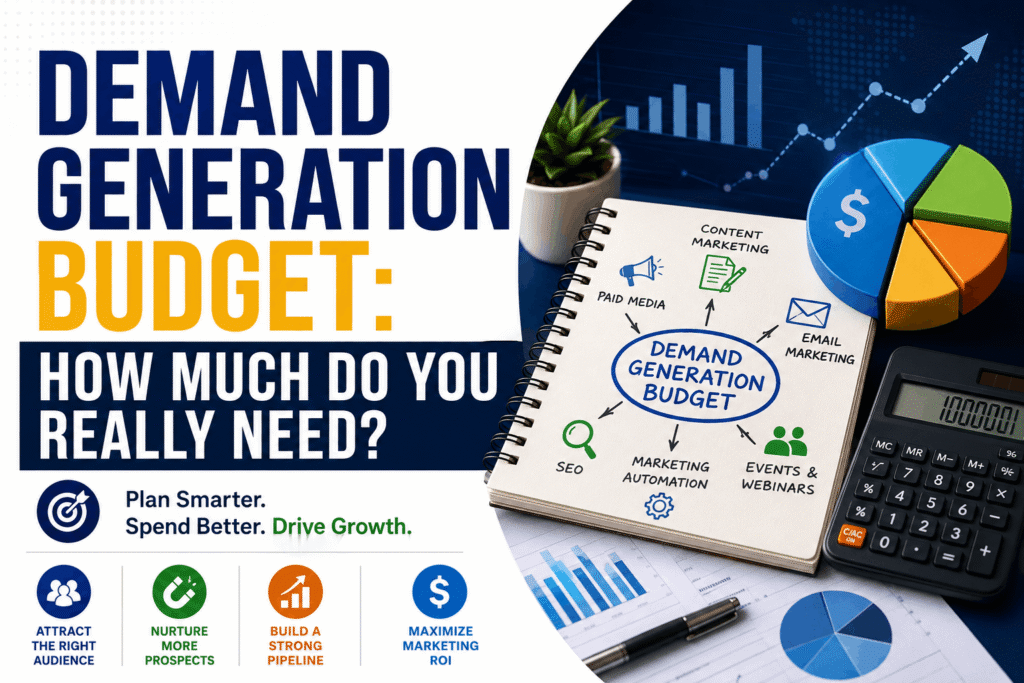
A typical budget may cover:
- Content marketing
- SEO
- Paid search advertising
- LinkedIn advertising
- Email marketing
- Marketing automation
- Webinars and virtual events
- Content syndication
- Intent data platforms
- Analytics and reporting tools
The goal isn’t to spend more. It’s to invest enough in the right areas to create consistent pipeline growth.
Why Many B2B Companies Underspend on Demand Generation
Marketing budgets often look reasonable on paper.
The problem becomes obvious once campaigns begin.
A company might allocate funds for Google Ads, publish a few blog posts each month, sponsor a webinar, and send occasional email campaigns. Individually, each tactic has potential. Together, they rarely produce enough impact if every channel receives only a small share of the budget.
This creates a common situation where marketing appears active, but pipeline growth remains flat.
Several factors contribute to underfunding.
Short-Term Revenue Expectations
Some organizations expect demand generation to produce immediate sales.
That expectation doesn’t match how B2B buyers make decisions.
Enterprise purchases often involve multiple stakeholders, product evaluations, security reviews, and budget approvals. Building trust takes time, and campaigns need enough investment to stay visible throughout that process.
Reducing the budget after only a few weeks often prevents campaigns from reaching their full potential.
Too Many Channels, Too Little Investment
Modern marketers have access to dozens of marketing platforms.
Search engines.
LinkedIn.
Industry publications.
Email campaigns.
Display advertising.
Video.
Podcasts.
Trying to maintain a presence on every channel without adequate funding usually weakens overall performance.
A focused Demand Generation Strategy often delivers stronger results than spreading resources across every available platform.
Ignoring the Cost of Buyer Education
Not every visitor is ready to buy today.
Some are researching solutions.
Others are comparing vendors or gathering information for future projects.
Educational content plays a major role during this stage.
Blog articles, whitepapers, industry reports, webinars, and case studies require ongoing investment. Companies that reduce content budgets often lose visibility before buyers are ready to make purchasing decisions.
Signs Your Demand Generation Budget Is Too Small
Marketing performance usually reveals whether the budget matches business goals.
If several of these challenges sound familiar, the issue may be budget allocation rather than campaign quality.
Campaigns End Before They Produce Results
Paid advertising platforms need time to collect performance data.
SEO requires months of consistent publishing.
Email nurture campaigns improve as audience insights grow.
Stopping campaigns too early prevents optimization and limits long-term returns.
Consistency matters more than short bursts of activity.
Your Sales Pipeline Depends on One Channel
Some businesses generate nearly every opportunity from referrals or outbound sales.
While these channels remain valuable, relying on a single source creates unnecessary risk.
A balanced B2B Demand Generation Budget supports multiple acquisition channels, reducing dependence on any one tactic.
Marketing and Sales Work Toward Different Goals
Marketing celebrates website traffic.
Sales focuses on closed revenue.
Without enough investment in nurturing and qualification, both teams measure success differently.
A well-funded demand generation program creates better alignment by delivering prospects who are informed, engaged, and closer to making a purchasing decision.
You’re Collecting Leads Instead of Building Demand
High lead volume doesn’t always translate into business growth.
If prospects download one resource and never return, your campaigns may be optimized for lead quantity rather than buyer readiness.
Effective demand generation invests in ongoing engagement through Email Marketing, personalized content, remarketing, and Marketing Automation to keep prospects moving through the buying journey.
Why Budget Size Directly Impacts ROI
One of the biggest misconceptions in B2B marketing is that a smaller budget automatically produces a better return.
In reality, campaigns with extremely limited funding often struggle to generate statistically meaningful data.
For example, a paid search campaign with only a few clicks each day provides little insight into audience behavior. Without enough traffic, marketers can’t accurately test headlines, landing pages, audience segments, or offers.
The same principle applies to Content Marketing and SEO.
Publishing one article every few months rarely builds topical authority or improves organic visibility against established competitors.
A larger, well-managed Demand Generation Budget creates enough activity to identify what works, eliminate ineffective tactics, and scale campaigns that consistently contribute to pipeline growth.
How to Build the Right Demand Generation Budget
There isn’t a universal budget that works for every business.
A startup selling project management software has different priorities than an established cybersecurity company targeting Fortune 500 enterprises.
Instead of copying another company’s marketing spend, start with your revenue goals and work backward.
Ask questions such as:
- How many qualified opportunities do you need each month?
- What is your average conversion rate?
- How long is your sales cycle?
- Which marketing channels generate the highest-quality leads?
- What is your customer acquisition cost (CAC)?
These numbers provide a stronger foundation than choosing an arbitrary percentage of annual revenue.
Companies that review these metrics regularly are better positioned to adjust spending before performance declines.
Budget Allocation Across Marketing Channels
A successful Demand Generation Strategy rarely depends on a single marketing channel.
Instead, investment is spread across activities that attract, educate, and nurture buyers throughout their journey.
The percentages below represent a common starting point for many B2B organizations.
| Marketing Channel | Recommended Budget Allocation |
| Content Marketing | 25% |
| SEO | 20% |
| Paid Search & LinkedIn Ads | 25% |
| Email Marketing & Marketing Automation | 15% |
| Webinars & Virtual Events | 10% |
| Analytics & Testing | 5% |
These percentages aren’t fixed rules.
If organic search already drives strong results, increasing investment in SEO and content may produce a better return than expanding paid advertising.
The key is to invest where qualified buyers already engage with your brand.
Measure the Metrics That Influence Revenue
Website traffic can look impressive in monthly reports.
Revenue tells a different story.
A healthy Demand Generation Budget should be measured against business outcomes instead of vanity metrics.
Focus on indicators such as:
- Marketing Qualified Leads (MQLs)
- Sales Qualified Leads (SQLs)
- Pipeline Contribution
- Customer Acquisition Cost (CAC)
- Cost Per Opportunity
- Customer Lifetime Value (CLV)
- Return on Marketing Investment (ROMI)
- Revenue Influenced by Marketing
Tracking these metrics helps identify which campaigns deserve additional investment and which should be optimized or discontinued.
Common Budgeting Mistakes That Slow Growth
Even experienced marketing teams can misallocate resources.
Avoiding these common mistakes can improve campaign performance without dramatically increasing overall spending.
Focusing Only on Lead Volume
A thousand low-quality leads won’t outperform one hundred buyers who match your ideal customer profile.
Quality should always take priority over quantity.
Invest in channels that consistently deliver decision-makers rather than simply increasing form submissions.
Cutting SEO Too Early
SEO is a long-term investment.
Businesses often stop publishing content before search engines have enough time to recognize topical authority.
Consistent publishing, technical improvements, and high-quality backlinks typically produce stronger results over time than short-term campaigns.
Underinvesting in Lead Nurturing
Generating interest is only the first step.
Many prospects need weeks or months before making a purchasing decision.
Without Email Marketing, remarketing campaigns, and Marketing Automation, valuable opportunities often disappear before sales teams can engage them.
Ignoring Campaign Testing
No marketing strategy remains effective forever.
Audience behavior changes.
Competition increases.
Advertising costs fluctuate.
Allocate part of your Demand Generation Budget to testing new headlines, landing pages, creative assets, audience segments, and offers.
Small improvements in conversion rates often produce significant gains over time.
Align Marketing Investment With Sales Goals
Marketing and sales should measure success using the same business outcomes.
When both teams work toward shared pipeline and revenue targets, budget decisions become easier.
For example:
- Marketing identifies high-intent prospects through Content Marketing, SEO, and paid campaigns.
- Sales prioritizes follow-up based on engagement and buying signals.
- Marketing continues nurturing prospects who aren’t ready to purchase.
- Performance data is shared to improve future campaigns.
This alignment reduces wasted spending and improves conversion rates throughout the sales funnel.
Demand Generation Is an Ongoing Investment
Demand generation isn’t something businesses turn on for one quarter and pause the next.
Buyers continue researching throughout the year.
Competitors continue publishing content.
Advertising platforms continue evolving.
Maintaining visibility requires consistent investment rather than occasional spending spikes.
Companies that treat their Demand Generation Budget as a long-term growth investment are often better positioned to build stronger brand awareness, generate qualified pipeline, and create predictable revenue over time.
