
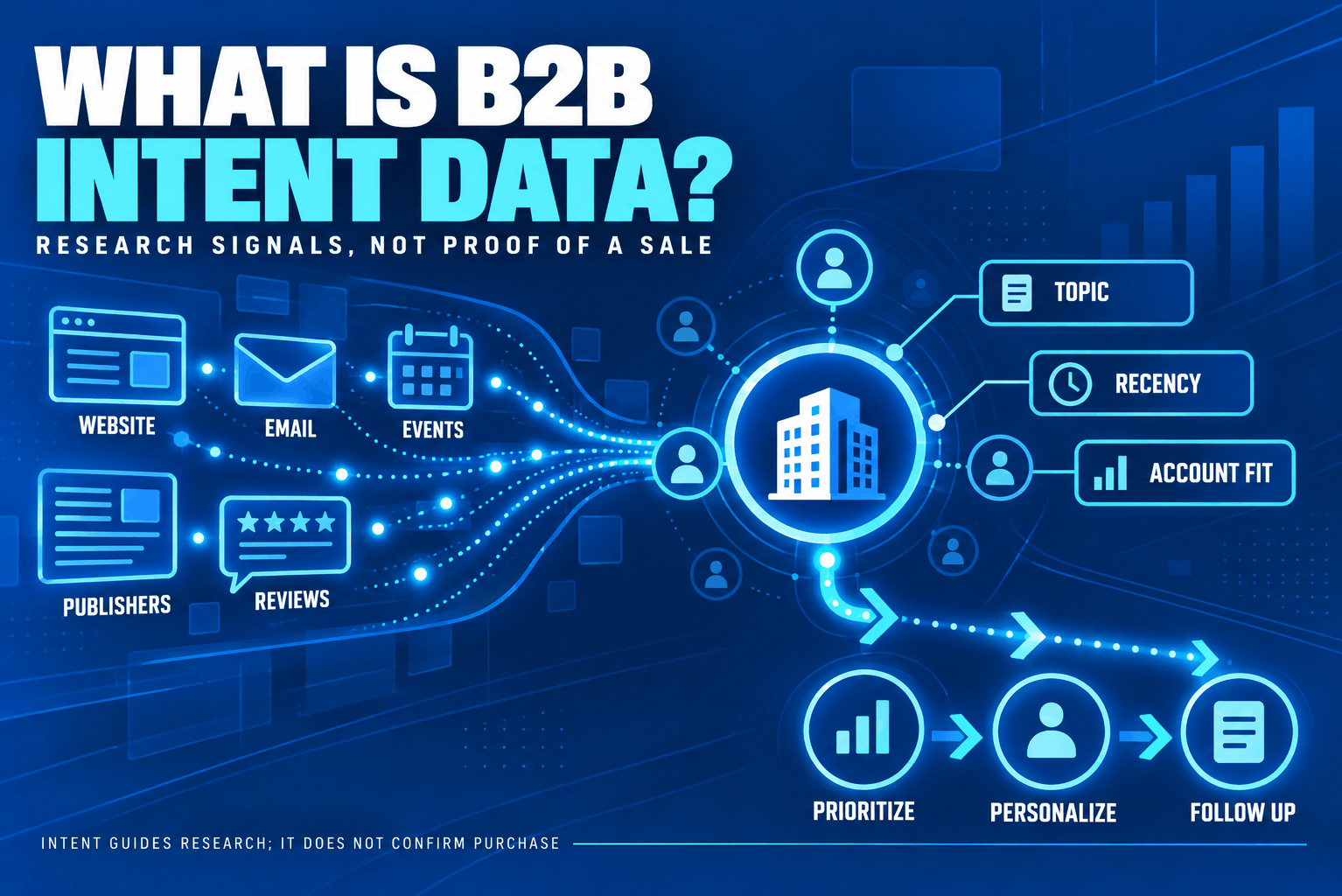
A company visits your pricing page once, downloads a guide three weeks later, and then goes quiet. Another account has never filled out your form, but several people there have recently compared vendors and researched the problem you solve. Which account should sales contact first? B2B intent data helps answer that question by turning research activity into signals that can guide account priorities. The useful outcome is a better-informed next step, not a promise of a sale. It does not confirm that a purchase is coming. It gives marketing and sales a better reason to investigate.
That distinction matters. B2B intent data is most helpful when teams use it to decide what to check next. Teams often buy an intent feed expecting a list of ready-to-buy companies. What they receive is activity data: topics being researched, visits to certain pages, or a rise in consumption compared with a baseline. Without a fit check, context and follow-up plan, the signal is just another dashboard alert.
What B2B intent data means
B2B intent data is behavioral information that suggests a business account may be researching a problem, product category or solution. Put plainly, B2B intent data records a pattern that may warrant attention. It can come from a company’s own channels, a partner’s audience or activity observed across external sites and content networks. The useful unit is often the account rather than one named person, because business purchases commonly involve several colleagues with different roles.
A person reading one article might be curious, doing research for a client, or gathering background for a project that has no budget. B2B intent data helps more when it reflects a repeated pattern than one isolated visit. Comparing several recent visits can separate fleeting curiosity from a persistent research track. Even then, intent is a clue, not a buying decision. Demandbase makes this qualification clearly in its definition: an intent signal indicates increased research, but cannot establish with certainty that an individual is ready to buy.
For a practical example, imagine a software firm selling contract-management tools to legal operations teams. Its B2B intent data should connect topic signals to the accounts it can actually serve. Research into “contract lifecycle management” is relevant. A sudden rise in that topic at a large legal department might merit review. If the same account is far outside the firm’s customer profile, however, the signal should not jump straight to an urgent sales call. Fit and intent answer different questions.
First-party, second-party and third-party signals
First-party B2B intent data comes from interactions with channels your organization controls. This form of B2B intent data shows what an account does on your own properties. Examples include visits to solution pages, repeat sessions, event attendance, email clicks, product trials, demo requests and content downloads. These actions can show what an account does after it has encountered your brand. They are useful for identifying which topics draw attention and where a prospect pauses in your own buying journey.
First-party data has limits. B2B intent data from your own site cannot show every account researching away from your channels. Anonymous visitors may not be identifiable, and known contacts rarely represent everyone involved in a purchase. A form submission can also be low-intent: someone might download a checklist for a class, a client project or general research. Check the action against the account’s fit and its other activity before routing it to a seller.
Second-party data usually means another organization’s first-party information made available through an agreed partnership. In some programs, this gives B2B intent data a view beyond your own channels. A publisher, event host or review platform might share signals under defined terms. This can fill a gap in your own activity record, but it is worth asking exactly what the partner collected, how it was collected and what use the agreement allows.
Third-party data is collected from outside your own properties and licensed or otherwise made available to buyers. This can expose research before a prospect visits your website. It can reveal research before a prospect visits your website. Sources differ: some providers build topic-level views from publisher networks; others focus on a review marketplace, specific content environments or ad-related signals. This is why two tools both labeled “intent” may not cover the same behavior.
What the signals can and cannot tell you
A reliable B2B intent data workflow treats signals as evidence with varying weight, not as a verdict. Teams should read B2B intent data according to the action that created the signal. A pricing-page visit or direct comparison may show a more specific evaluation than a broad category-page view. G2’s documentation, for example, distinguishes product profile, pricing, alternatives, category and comparison activity; it describes these as different buyer interactions rather than interchangeable events.
A topic surge is a change in activity against some reference level. This is why B2B intent data scores need an explanation, not just a color or rank. It does not tell you who controls the budget, what the buying timeline is, whether the account has selected a vendor, or whether your product is on a shortlist. Nor does one signal reveal the whole buying group. The sales rep still needs to check company fit, current relationships, open opportunities and the contact’s role.
Watch for false confidence in a single score. A score can hide the logic that produced it. Ask whether it reflects recency, frequency, topic match, number of people researching, depth of content use or simply a one-off event. If the provider cannot explain its signal in plain language, your team will have a hard time deciding what action is reasonable.
How B2B intent data providers differ
When comparing B2B intent data providers, start with the source of the signal, not the size of the dashboard. Ask how each source adds useful account-research context to your current view. Ask whether the provider observes activity on your website, a review platform, a publisher network or a broader content pool. Ask what each source can see and what it misses. A narrowly sourced feed may be useful for a particular use case, but it should not be mistaken for a complete view of account research.
Then test coverage against your actual market. B2B intent data should reflect the terms your buyers use, not only a vendor’s default topic list. Does the provider track the topics your buyers use, including adjacent terms and common wording? Can it cover the industries and company sizes in your target-account list? Ask for sample records from accounts you already know. A large database is of little use if it is thin in your niche or if topic categories are too broad to inform a real conversation.
Ask how the vendor creates a signal. A clear explanation helps you judge the B2B intent data rather than accepting an opaque score. Does it classify content by topic, compare activity with a historical baseline, and consider how often or how deeply content was consumed? What is the time lag between an activity and the alert? Is the signal tied to a company through a method the provider can explain? These questions help your team judge whether B2B intent data providers are giving you timely evidence or just a polished score.
Check delivery and use. The B2B intent data must reach the people and systems that can act on it. Can the data reach your CRM, marketing automation system or account-planning workflow without a manual export? Can you filter by topic, date, account and signal type? Can a rep see why an account appeared, rather than only a number? Ask about licensing, permitted activation, retention, privacy notices and deletion processes. A signal that cannot lawfully or practically be used in your outreach is not a useful signal.
Finally, ask how you will know the provider is worth renewing. Your test should show whether B2B intent data adds useful information beyond current tools. Agree on a test period and a comparison group. Track whether the data leads to more qualified conversations or faster discovery, not merely more alerts or emails. Vendor demos tend to show ideal records. Your own accounts will show whether the feed adds something your CRM and website analytics do not already tell you.
Put intent into B2B lead generation marketing
A useful B2B lead generation marketing process starts with an ideal customer profile. Add B2B intent data only after those account-fit rules are clear. Define the account characteristics that make a company a plausible customer: sector, size, business model, systems already in use, geography if relevant to your business, and the operational problem you address. Keep the criteria narrow enough that a salesperson can explain why an account belongs on the list.
Next, set a rule for acting on intent. B2B intent data should trigger a defined review, not an automatic sales email. For instance, an account may qualify for sales research when it matches the profile and shows recent activity on two or more relevant topics. A pricing or comparison action might trigger a faster review; a broad topic spike might place the account into a useful educational sequence. These thresholds should reflect your sales cycle and data source, not an arbitrary number copied from a vendor demo.
A simple sequence can work like this: marketing sees a recent increase in research on a target topic; an account owner checks the company, current CRM notes and active sales work; the rep then chooses a relevant first touch. This turns B2B intent data into a specific account check. If there is no direct contact, marketing can serve an article, webinar invitation or case example tied to the topic. The message should help with the problem the account appears to be researching. “We noticed you are researching this” is rarely a good opening; it can sound intrusive and does not give the buyer a reason to reply.
B2B lead generation marketing should not convert every signal into cold outreach. A human review keeps B2B intent data from becoming an excuse for unwanted contact. One account may need a useful explainer, while another has already compared vendors and wants a technical conversation. Let the signal influence the subject and timing, but allow sellers to use judgment. If the first response is “not now,” record that and adjust the cadence rather than letting an automated sequence keep pressing.
Measure the work beyond lead volume. The feed earns a place in the program only if it contributes to better account decisions or pipeline outcomes. Track the share of intent-prioritized accounts that meet your profile, meaningful replies, accepted meetings, sales-qualified opportunities, pipeline created and conversion over a suitable period. Compare those results with similar accounts that did not receive intent-led treatment. Otherwise, a team may credit intent for deals that would have arrived through existing referrals or inbound demand.
Make it part of your B2B digital strategy
A B2B digital strategy should connect the signal to a clear action. In practice, B2B intent data should change what content or follow-up the account receives. If the company sees research about implementation pain, does the site have a useful implementation guide? If prospects compare vendors, can they find an honest product comparison and clear pricing information? If not, the intent feed may expose a content gap rather than a reason to buy another tool.
Map important topics to pages, campaign assets and sales conversations. This gives B2B intent data a useful destination across marketing and sales. Use a modest topic list at first. Too many loosely related terms create noise and make it difficult to tell what the account cares about. Review query and activity patterns with sales, customer-facing teams and subject experts. They can often spot when a label is too broad or when an important buyer phrase is missing.
The same B2B digital strategy needs measurement and data governance. B2B intent data is still behavioural information, so document its source and intended use. Decide what counts as a meaningful action, where the data is stored, who can access it and how long it is retained. Give visitors clear privacy information and honour consent choices where required. Google’s tag guidance, for example, describes setting consent defaults and updating them when users make a choice; teams using tracking tools should configure them to follow their own policy and applicable requirements.
Treat outbound email with similar care. Buying a contact record does not remove the need to use accurate sender details, relevant subjects and working opt-out handling. The FTC’s commercial-email guide says its requirements apply to business-to-business messages as well as bulk mail, including clear opt-out handling. Rules vary by jurisdiction, so get qualified advice for the markets and channels you use rather than assuming one checklist covers every case.
A small test before a large contract
Before buying a year of data, select a compact group of target accounts and a handful of high-value topics. This lets you test B2B intent data on accounts your team understands. Write down what counts as a signal, what action follows and what success means. Keep a comparison group that receives your usual marketing and sales treatment. Run the test long enough to cover the normal response cycle; a two-week snapshot may reward a quick email rather than a meaningful pipeline result.
Review the records with the people who will use them. Ask them whether B2B intent data gave a useful reason to prioritise an account. Ask sales whether the company match was right, whether the topic fit the account’s business, and whether the suggested timing helped. Ask marketing if the signals changed content choices or audience exclusions. If the only reported result is “we got 400 accounts”, the test has not answered the business question.
B2B intent data can help an account owner choose what to check next. For example, a representative could verify account fit, note the research topic, then select a useful next conversation. Intent Flow Media’s existing guide to using B2B intent data for lead generation and B2B demand generation plan show how account signals fit into a campaign workflow.
FAQs
What is B2B intent data?
B2B intent data is behavioural information that suggests a company is researching a business problem, product category, or solution. It can include activity on a company’s website or research across external sites.
How should businesses use B2B intent data?
Use it to prioritise accounts, tailor relevant content, and guide sales research. Combine the signal with account fit and CRM context; intent data alone does not confirm that a company is ready to buy.
How do you choose a B2B intent data provider?
Check the provider’s data sources, topic coverage, signal freshness, account-matching method, privacy practices, and CRM integrations. Test sample signals against accounts your team already knows before committing.
