
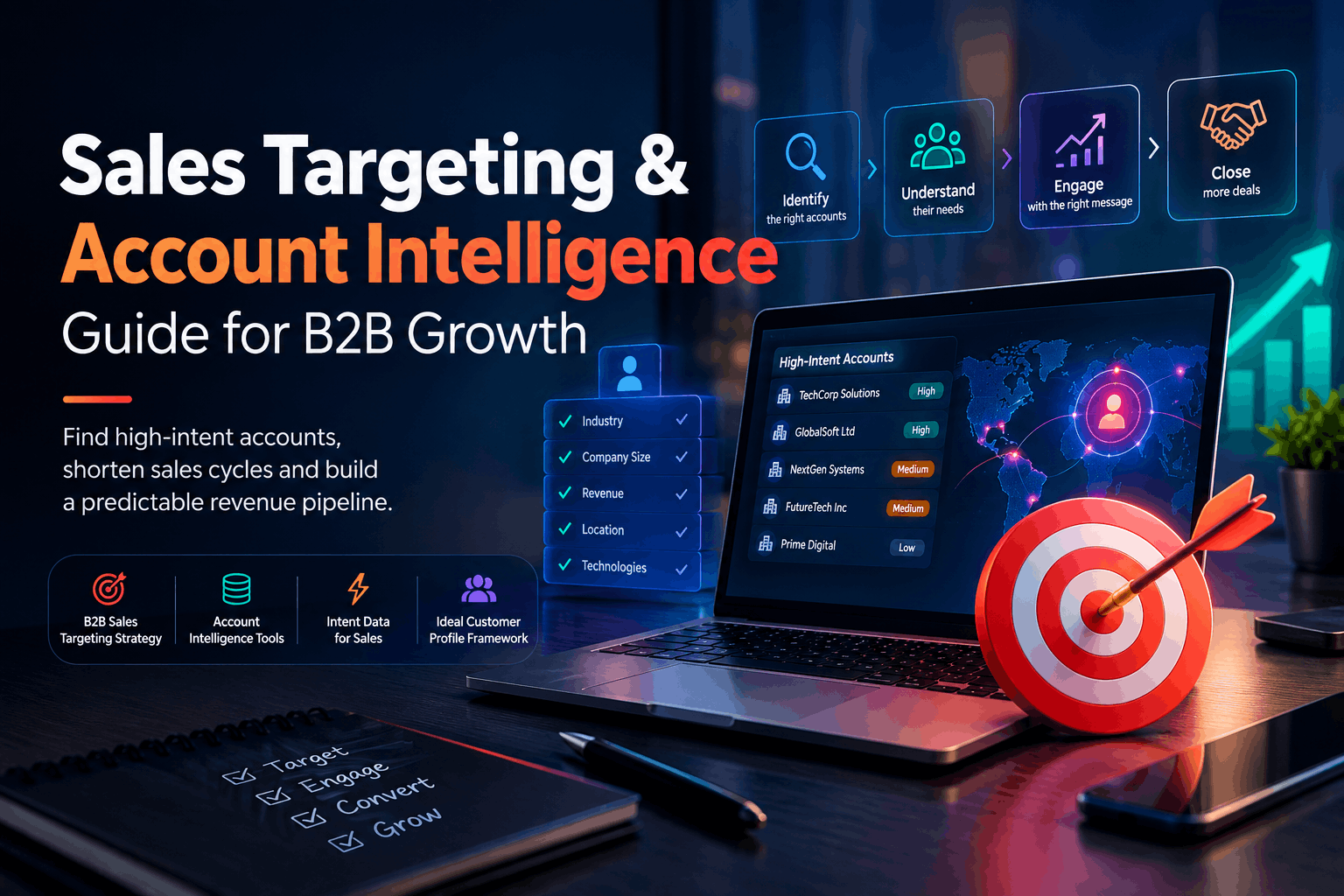
Sales Targeting and Account Intelligence can change how a B2B sales team decides who to contact, when to reach out, and what to say. Instead of giving sales reps a large list of companies and asking them to work through it, teams can narrow the market using company details, buyer roles, technology information, engagement activity, and signs of purchase interest.
That difference matters when sales cycles are long and several people are involved in a buying decision. Ten good accounts can be more useful than hundreds of names that have little connection to what you sell.
What Is Sales Targeting and Account Intelligence?
Sales Targeting and Account Intelligence brings two related jobs together.
Sales targeting is about deciding which companies belong on the sales team’s list.
Account intelligence adds the information needed to understand those companies.
That can include company size, industry, revenue range, technology used, locations, growth activity, seniority of key employees, and recent buying signals.
For a B2B company, this information helps answer a basic question:
Who should the sales team spend time on right now?
A software company selling an enterprise security platform, for example, may have thousands of potential customers. But only a portion may have the right company size, technology environment, budget, and business need.
A good targeting process helps narrow that group before sales outreach begins.
Why B2B Sales Targeting Needs More Than a Company List
A spreadsheet containing company names and email addresses isn’t enough to build a useful B2B sales targeting strategy.
Sales teams need context.
Two companies in the same industry can have completely different buying situations. One may have recently expanded its technology team and started researching a new platform. Another may have no plans to change its existing system.
Treating both accounts the same creates unnecessary work.
A better approach is to build account groups based on factors that actually matter to the sale.
For example:
- Industry
- Employee count
- Revenue range
- Location
- Technology stack
- Existing vendors
- Recent hiring
- Expansion activity
- Relevant business problems
- Buying signals
- Key decision-makers
The result is a sales list built around potential fit rather than simply database availability.
Build an Ideal Customer Profile First
Before choosing accounts, sales and marketing teams need a clear ideal customer profile framework.
An ICP describes the type of company most likely to benefit from a product or service.
It might include:
- Company size
- Industry
- Geographic market
- Annual revenue
- Technology used
- Business model
- Typical buying problem
- Department affected
- Buying committee structure
The ICP should be specific enough to guide account selection.
For example, “B2B technology companies” is too broad for many sales teams.
A more useful profile could describe US and UK B2B software companies with 200–2,000 employees, a specific technology stack, an established sales team, and a known need for a particular type of solution.
That gives the sales team something they can actually work with.
IntentFlow Media’s sales targeting service follows a similar account-level approach, using firmographic, technology, behavioral, and buying information to help identify relevant organizations.
Where Account Intelligence Tools Fit
Modern account intelligence tools can bring several pieces of information into one account view.
Instead of checking multiple sources every time a rep researches a company, the team can look at information such as:
- Company firmographics
- Revenue and growth indicators
- Technology information
- Employee changes
- Key contacts
- Department structure
- Engagement activity
- Research behavior
- Relevant buying signals
The point isn’t to collect every possible data point.
Too much information can become another problem.
Sales reps need the details that help them decide whether an account is worth contacting and how that conversation should begin.
For a sales manager, account intelligence can also make territory planning easier. Accounts can be grouped by market, size, industry, buying stage, or sales potential instead of being distributed randomly.
How Intent Data for Sales Changes Timing
A company can match your ICP and still have no reason to talk to you today.
This is where intent data for sales becomes useful.
Intent signals can show that a company or group of people is actively researching a topic connected to your product.
For instance, a company may begin consuming content about replacing an existing system, researching vendors, comparing solutions, or investigating a problem your product addresses.
That doesn’t guarantee a purchase.
It does give the sales team additional context.
Imagine two accounts have almost identical firmographic profiles.
Account A has shown no recent interest in the problem you solve.
Account B has been researching that problem and several related topics.
The second account may deserve attention sooner.
IntentFlow Media describes intent detection around topic-level interest, account buying signals, behavioral activity, and research behavior.
Account Intelligence Helps Identify the Right People
Finding the right company is only half the job.
B2B purchases often involve several people. A department head may care about one part of the purchase while finance, IT, procurement, or senior leadership cares about something else.
This is where persona and stakeholder information becomes useful.
A sales team can map:
- Decision-makers
- Influencers
- Department heads
- Technical stakeholders
- Procurement contacts
- Executive sponsors
The message can then reflect the person’s role.
A technical buyer may want implementation details.
A finance leader may want to understand cost and business impact.
A department head may care about how the solution affects their team’s workload.
Sending the same message to everyone rarely makes sense.
Turn Account Signals Into Sales Priorities
Having account information is one thing. Deciding what to do with it is another.
A simple prioritization model can combine three areas:
Account fit + buying activity + engagement
An account with a strong ICP match but no current activity may belong in a nurture program.
An account with a strong fit and clear buying activity may deserve direct sales attention.
An account showing engagement from several relevant people may need faster follow-up.
This approach gives sales teams a reason behind their priorities.
It also makes conversations between sales and marketing easier because both teams can work from the same account information.
Common Problems With Sales Targeting
Poor targeting usually starts before the first sales email is written.
One problem is an ICP that is too broad. If almost every company qualifies, the ICP isn’t helping the sales team make decisions.
Another is old account data. Companies change. People move roles. Technology changes. Business units are acquired or closed.
There is also the problem of treating intent as certainty.
Intent data for sales can indicate research activity, but it doesn’t mean a company has approved a budget or selected a vendor.
Sales teams still need to qualify the opportunity.
The same applies to account intelligence tools. More data doesn’t automatically mean better targeting. The useful question is whether the information helps a rep make a better decision.
A Practical Sales Targeting Process
A B2B team can build its targeting process around five steps:
1. Define the ICP
Use the ideal customer profile framework to describe the companies that fit your offer.
2. Build the account list
Filter potential companies using firmographic and technology criteria.
3. Add account intelligence
Identify relevant contacts, business changes, technology information, and organizational structure.
4. Add buying signals
Use intent data for sales to identify accounts showing relevant research or engagement.
5. Prioritize outreach
Give sales reps a smaller group of accounts with enough information to make the first conversation relevant.
This process also fits the account profiling, persona mapping, decision-maker identification, intent detection, and segmentation work described by IntentFlow Media.
For B2B teams, the real benefit is clarity. Sales reps know which accounts to investigate, marketing knows who campaigns are meant to reach, and both teams have more context before a prospect enters a sales conversation.
That is where Sales Targeting and Account Intelligence becomes useful in day-to-day sales work: fewer random names, better account context, and a clearer reason for contacting a company in the first place.
