
Getting traffic is easy.
Turning that traffic into pipeline and revenue is where most companies struggle.
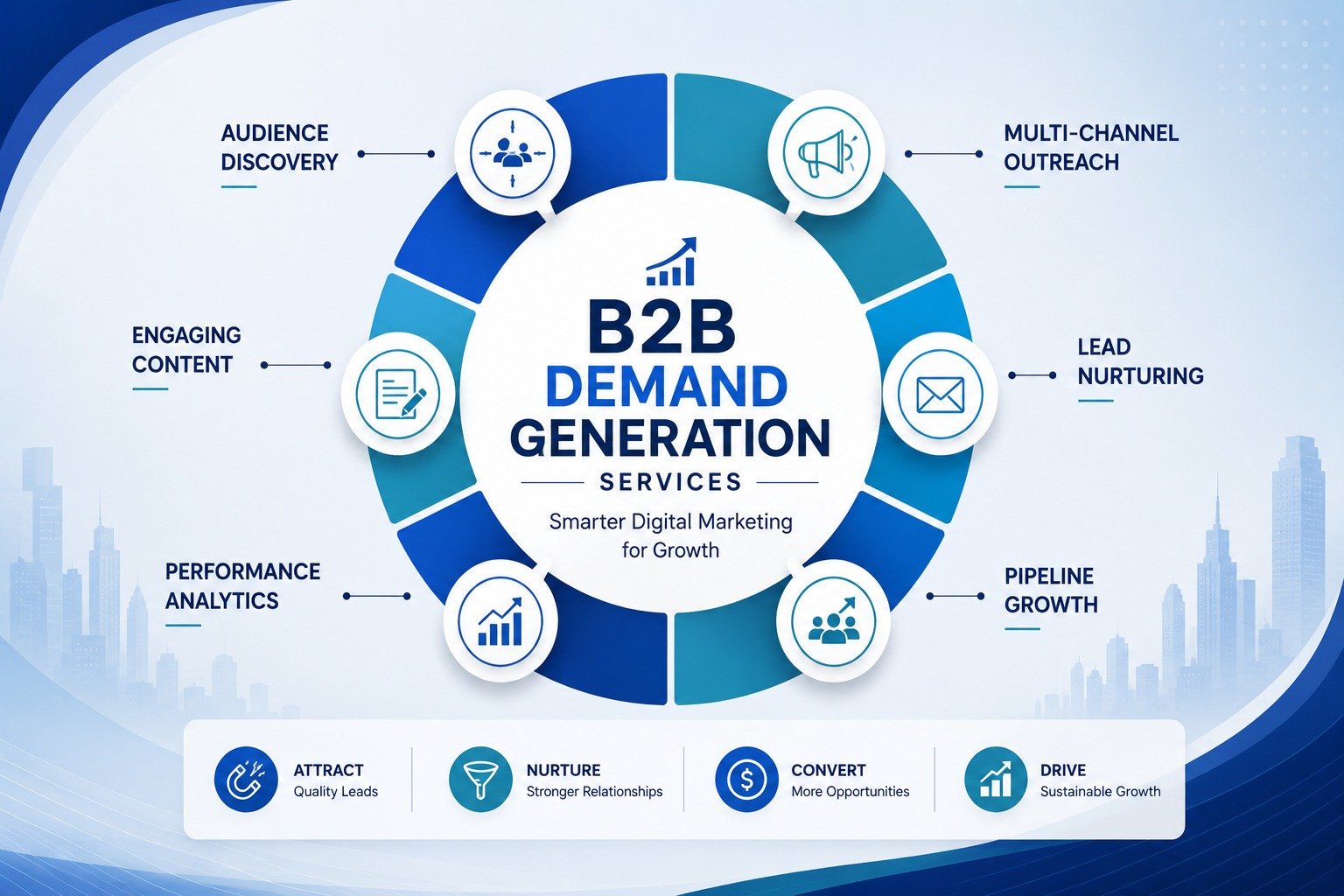
B2B Demand Generation Services help businesses attract the right audience, build trust, and create consistent sales opportunities. Today’s buyers don’t immediately book demos or respond to sales pitches. They research solutions, compare vendors, read reviews, and consume content before making a decision.
Businesses that rely only on cold outreach often run into the same issues: low-quality leads, longer sales cycles, and inconsistent revenue.
Combining Digital Marketing Services, intent data, content syndication, and marketing automation creates a more predictable growth engine.
Why Digital Marketing Matters More Than Ever
Digital marketing has changed.
It is no longer about simply publishing content or running advertisements.
It is about becoming visible when buyers are actively looking for solutions.
A strong digital strategy helps businesses:
- Improve search visibility
- Increase brand awareness
- Generate qualified leads
- Build trust with decision-makers
- Improve conversion rates
- Support long-term revenue growth
When combined with demand generation, marketing becomes a system that continuously feeds the sales pipeline.
How B2B Demand Generation and Digital Marketing Work Together
Every marketing channel supports a different stage of the buyer journey.
Some channels create awareness.
Others nurture prospects until they are ready to speak with sales.
Search Engine Optimization (SEO)
SEO helps businesses appear when prospects search for products or services online.
Publishing educational content around relevant topics increases organic visibility and attracts buyers already looking for solutions.
Unlike paid campaigns, SEO continues to generate traffic long after content has been published.
Related Service:
Content Marketing
Buyers want answers before they make decisions.
Blogs, whitepapers, case studies, webinars, and industry reports help businesses educate prospects while establishing authority.
Useful content also supports Lead Generation Services by attracting visitors earlier in the buying journey.
Social Media Marketing
LinkedIn has become one of the most valuable channels for B2B marketing.
Sharing industry insights and participating in conversations helps businesses build credibility and stay visible among decision-makers.
Social platforms also support demand generation by keeping brands in front of potential buyers during long sales cycles.
Email Marketing
Email continues to deliver strong results in B2B marketing.
Personalized campaigns help businesses stay connected with prospects, share useful information, and build relationships over time.
Related Article:
👉 Email Lead Nurturing Best Practices
Paid Advertising
Organic growth takes time.
Paid campaigns allow businesses to quickly reach target audiences while testing messaging, offers, and landing pages.
The strongest strategies usually combine both paid and organic efforts.
Five Strategies That Drive Better Results (Benefits of B2B Demand Generation Services)
1. Use Intent Data to Target High-Value Buyers
Not every website visitor is ready to buy.
Intent Data helps businesses identify companies already researching similar solutions.
This allows marketing and sales teams to focus their efforts on prospects showing real buying signals.
Instead of reaching everyone, companies can prioritize the accounts that matter most.
2. Understand Buyers Through Intelligence Data
Every prospect behaves differently.
Some download several resources before requesting a demo.
Others engage with a single case study and quickly move forward.
Buyer Intelligence provides insights into:
- Content engagement
- Buying signals
- Industry interests
- Customer challenges
- Purchase intent
These insights help businesses create more relevant campaigns and improve personalization.
3. Expand Reach Through Content Syndication
Creating content is only part of the process.
People still need to discover it.
Content Syndication distributes blogs, reports, eBooks, whitepapers, and webinars across trusted industry platforms.
This expands reach and introduces businesses to audiences beyond their own website.
Related Service:
👉 B2B Lead Generation Services
Content syndication can also help generate high-quality leads by placing valuable content in front of decision-makers already interested in similar topics.
4. Automate Lead Nurturing
Modern buyers expect timely communication.
Marketing automation allows businesses to deliver personalized experiences without manually managing every interaction.
Automation can help teams:
- Send targeted emails
- Score leads automatically
- Trigger follow-up sequences
- Deliver relevant content
- Track engagement activity
The goal is not to replace human interaction.
The goal is to make every interaction more relevant.
5. Align Sales and Marketing Teams
One of the biggest reasons demand generation efforts fail is poor alignment.
Marketing focuses on lead volume.
Sales focuses on revenue.
If both teams operate independently, opportunities are often lost.
Sharing customer insights, lead qualification standards, and campaign performance data creates stronger collaboration and better conversion rates.
Traffic Means Very Little Without Revenue
Website traffic can look impressive.
Revenue tells the real story.
Businesses should focus on metrics that directly impact growth, including:
- Marketing Qualified Leads (MQLs)
- Sales Qualified Leads (SQLs)
- Conversion Rate
- Customer Acquisition Cost (CAC)
- Customer Lifetime Value (CLV)
- Pipeline Contribution
- Return on Marketing Investment (ROMI)
These metrics provide a clearer understanding of marketing performance and business impact.
Trends Shaping the Future of Demand Generation
Buyer behavior continues to evolve.
Businesses that adapt early often gain a significant advantage.
Predictive and Data-Driven Marketing
Companies increasingly rely on analytics and automation to improve targeting and campaign performance.
First-Party Data Strategies
As privacy regulations continue to change, businesses are investing more heavily in their own customer data.
First-party data helps companies create more personalized experiences while reducing dependence on third-party sources.
Interactive Content
Webinars, assessments, calculators, and interactive tools are becoming more effective at engaging buyers than static content alone.
Account-Based Marketing (ABM)
Instead of targeting broad audiences, companies are focusing on high-value accounts with highly personalized campaigns.
Related Article:
👉 B2B Digital Lead Generation: 15 Proven Strategies
Revenue Operations (RevOps)
Sales, marketing, and customer success teams are increasingly working together through shared processes, technology, and reporting.
Businesses that embrace these changes are better positioned to create predictable growth and build stronger customer relationships.
For companies looking to improve pipeline quality and generate sustainable growth, combining B2B Demand Generation Services, Digital Marketing Services, content syndication, buyer intelligence, and automation creates a more effective and scalable approach to modern B2B marketing.
