
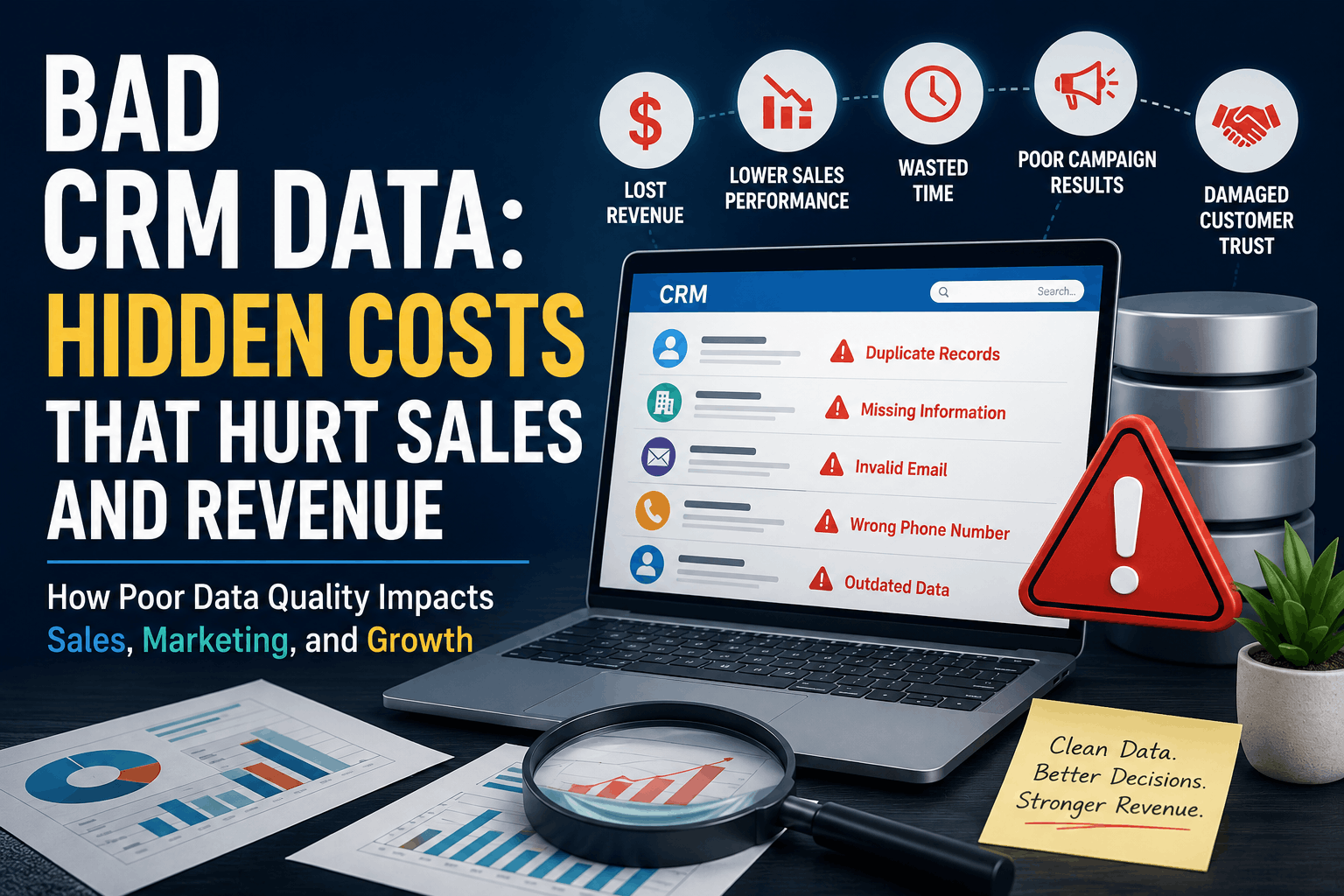
Most companies don’t realize they have a data problem until revenue starts slowing down. Bad CRM data quietly affects sales performance, marketing campaigns, customer experience, and reporting accuracy. Duplicate records, outdated contact information, missing fields, and incorrect company details create friction across teams. What looks like a minor database issue can eventually become a serious growth problem.
For many businesses, the real expense isn’t software. It’s the decisions being made using incomplete or inaccurate information.
What Is Bad CRM Data?
Bad CRM data refers to inaccurate, outdated, incomplete, or duplicated information stored inside a customer relationship management system.
A few common examples include:
- Wrong email addresses
- Duplicate company records
- Employees listed at companies they left years ago
- Missing job titles
- Incomplete phone numbers
- Incorrect company revenue data
Sales and marketing teams rely on CRM information every day. When the data becomes unreliable, every activity built on top of it becomes less effective.
Why CRM Data Quality Matters
A CRM should help teams make better decisions.
Instead, poor information often creates confusion.
Imagine a sales representative preparing for an important meeting only to discover that the decision-maker left the company six months earlier. Or a marketing team spending thousands of dollars on campaigns targeting industries that no longer fit their ideal customer profile.
Poor CRM data quality affects nearly every department.
Common problems include:
- Lower email engagement
- Poor lead scoring
- Inaccurate forecasting
- Reduced productivity
- Wasted advertising budgets
- Misaligned sales efforts
Small data issues compound over time.
One incorrect field becomes ten. Ten become thousands.
The Financial Cost of Poor CRM Data Quality
Businesses often underestimate how expensive bad data can become.
Sales representatives spend hours verifying information instead of selling.
Marketing teams send campaigns to invalid contacts.
Managers make strategic decisions using inaccurate reports.
A company with hundreds of thousands of records can lose significant revenue simply because its database cannot be trusted.
The hidden costs usually appear in several areas.
Lost Sales Opportunities
Outdated contacts mean missed conversations.
Wrong company information means targeting businesses that were never a good fit in the first place.
Sales teams may spend weeks pursuing accounts that have little chance of converting.
Reduced Productivity
Research consistently shows that sales professionals spend a surprising amount of time searching for information.
Bad data adds even more manual work:
- Updating records
- Removing duplicates
- Finding missing information
- Verifying contacts
None of these activities directly generate revenue.
Poor Forecasting
Leadership teams rely on CRM reports to predict pipeline growth.
If the underlying information is inaccurate, forecasting becomes unreliable.
This creates budgeting issues, hiring problems, and unrealistic growth expectations.

How CRM Data Problems Affect Marketing Campaigns
Marketing campaigns depend heavily on segmentation.
When contact data is inaccurate, campaigns become less relevant.
A software company may accidentally send enterprise content to small businesses. A manufacturing campaign may target healthcare companies simply because industries were categorized incorrectly.
The result?
Lower open rates.
Lower conversions.
Higher acquisition costs.
Good marketing starts with good information.
Common Causes of CRM Data Quality Issues
Bad data rarely appears overnight.
It usually builds slowly.
Manual Data Entry
People make mistakes.
Names are misspelled.
Fields are skipped.
Formats become inconsistent.
Over time, small errors accumulate.
Multiple Data Sources
Businesses often collect information from:
- Forms
- Events
- Purchased lists
- Sales teams
- Third-party tools
Without proper governance, these sources create duplicate and conflicting information.
Lack of Data Standards
One employee wrote “United States.”
Another writes “USA.”
Another enters “US.”
These inconsistencies make reporting and segmentation difficult.
Outdated Information
Companies change rapidly.
Employees switch jobs.
Businesses merge.
Revenue numbers change.
Without regular maintenance, databases become stale surprisingly fast.
Why Businesses Invest in CRM Data Cleansing
Cleaning CRM records isn’t glamorous work.
But it can significantly improve sales and marketing performance.
CRM data cleansing involves:
- Removing duplicates
- Correcting errors
- Standardizing records
- Updating outdated information
- Filling missing fields
Clean data helps teams move faster because they trust the information in front of them.
It also improves reporting accuracy and campaign performance.
The Role of CRM Data Enrichment
Cleaning existing information is only part of the solution.
Many companies also need additional data.
This is where CRM data enrichment becomes valuable.
Data enrichment adds missing details such as:
- Job titles
- Company size
- Industry information
- Revenue estimates
- Technology usage
- Direct contact details
These additional insights help teams prioritize better opportunities.
A sales team targeting software companies with more than 200 employees, for example, can build more accurate prospect lists and improve conversion rates.
Should Businesses Use Outsourced Data Enrichment?
Maintaining databases internally can become difficult as companies grow.
Large databases require continuous monitoring.
This is why many organizations turn to outsourced data enrichment providers.
External specialists can:
- Verify records
- Update missing information
- Remove duplicates
- Append firmographic data
- Improve database accuracy
For fast-growing companies, outsourcing often saves time and reduces operational costs.
However, choosing the wrong provider can create additional problems.
Not all data sources are equally reliable.
Businesses should evaluate vendors carefully and prioritize transparency regarding data collection methods.
How Better Data Improves Revenue
The benefits of clean data are usually visible quite quickly.
Sales teams spend less time researching.
Marketing campaigns become more targeted.
Forecasting becomes more reliable.
Customer experiences improve because communication becomes more relevant.
Better information also supports stronger customer data management, helping companies create more personalized experiences across the buyer journey.
Practical Steps to Improve CRM Database Management
Improving database health doesn’t require a complete rebuild.
Small changes often create meaningful results.
Establish Data Entry Standards
Create rules for naming conventions, formatting, and required fields.
Consistency matters.
Conduct Regular Audits
Review records periodically.
Remove outdated contacts.
Merge duplicates.
Update missing information.
Automate Validation Processes
Use tools that verify emails, company information, and phone numbers before records enter the CRM.
Monitor Data Quality Metrics
Track:
- Duplicate rate
- Record completeness
- Email bounce rates
- Data freshness
- Invalid contact percentages
These indicators reveal whether your database is improving or deteriorating.
Why Data Quality Should Be a Leadership Priority
Data problems are often treated as operational issues.
They’re not.
They’re revenue issues.
Every sales strategy, demand generation campaign, account-based initiative, and customer retention effort depends on accurate information.
Businesses with strong sales data accuracy make faster decisions because teams trust the numbers in front of them.
Businesses with poor data spend time questioning reports, fixing errors, and chasing opportunities that don’t exist.
Clean CRM information may never become the most exciting topic in a board meeting.
But it quietly influences nearly every growth decision a company makes.
