
Imagine a buyer who has read a few explainers, asked a colleague for a recommendation, and watched a product demo before booking a sales call. Your CRM may record only that final form. A solid Demand Generation Strategy accounts for the earlier work too: building familiarity before a buyer is shopping, then making a useful next step easy when interest turns into a project.
For B2B teams, that means more than collecting names. It means deciding which companies are a fit, understanding what their buying groups need to know, and giving sales enough context to follow up well. The phrase B2B lead generation marketing and digital strategy can sound like a list of channels. In practice, it should describe a connected path from market education to qualified conversations and measurable pipeline.
How a Demand Generation Strategy creates and captures demand
Demand generation covers two related jobs. Demand creation earns attention and trust before a buyer is ready to speak with sales. Demand capture makes it easier for someone already researching a solution to take a next step. HubSpot describes the work in those terms, while Salesforce distinguishes broad demand building from lead generation’s narrower task of collecting and qualifying contact details.
The distinction changes what a team measures. A guide download can show that someone wanted the guide. It does not tell you whether the person is part of a target buying group, whether the problem is urgent, or whether the company has a project underway. Treating each download as a sales-ready lead creates busywork for sales and frustration for buyers.
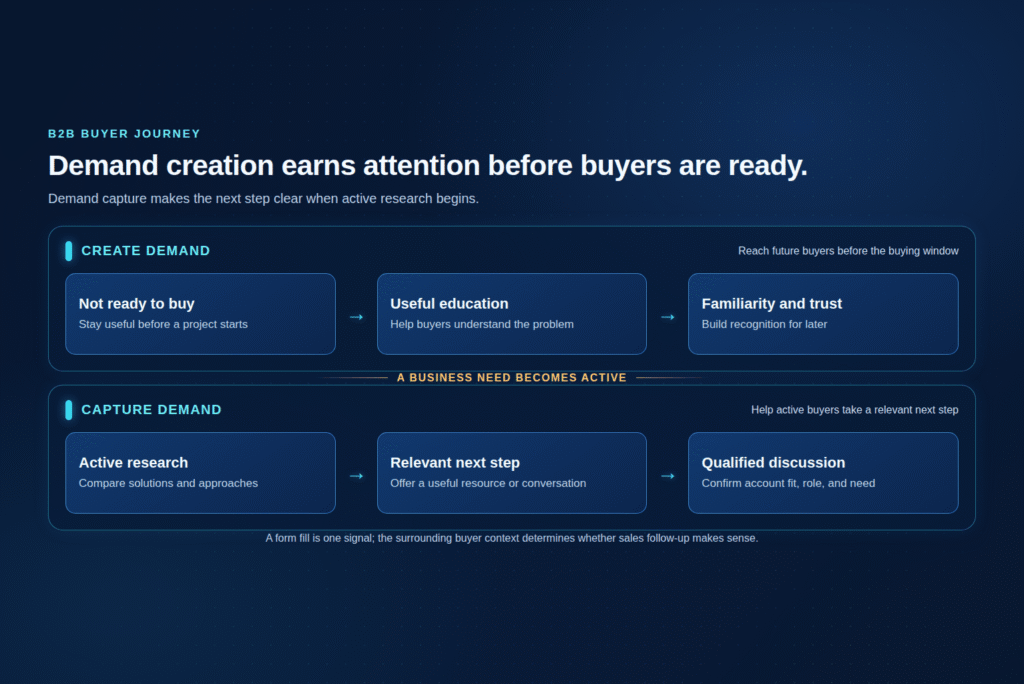
A useful Demand Generation Strategy puts both types of work on the plan. Educational content, expert-led posts, peer discussions, and paid reach can help a market understand a problem. Search pages, product comparisons, events, and clear contact paths can help active buyers evaluate options. The exact mix depends on how the product is bought, not on which channel is fashionable.
Start with the buying problem, not a channel list
Before planning a campaign, write down the business problem it is meant to address. “Grow pipeline” is too broad to guide targeting. A better brief names a segment, a problem the product solves, and the business change that makes the problem worth fixing now. For example: technology firms replacing fragmented lead data may need reliable account records before they increase outbound activity.
Then define the ideal customer profile, or ICP. Include firm size and industry where relevant, but also consider current systems, team structure, data readiness, compliance needs, and the trigger that could prompt a purchase. Ask sales to review recent wins, stalled deals, and losses. That conversation can reveal which signals matter and which assumptions were only guesses.
Map the buying group next. A technical evaluator may want to know how a tool fits the existing stack. A finance lead may ask what delay costs. A security reviewer may need evidence about access and data handling. One message rarely answers all three. A Demand Generation Strategy should set a shared commercial story, then let each asset answer the question that matters to its reader.
Plan for buyers who are not ready yet
Many B2B purchases happen infrequently. The LinkedIn B2B Institute’s 95-5 rule argues that most potential buyers in a category are not ready to buy at a given moment. It draws on examples of long purchase intervals and is best used as a planning lens, not as a fixed ratio that every market must follow.
The practical point is simple: a campaign judged only by this month’s form fills can miss the people who will enter a buying cycle later. Publish material that helps them recognize a costly problem, compare ways to solve it, or explain the change to colleagues. Make the useful part available without a form when that is the best way to earn trust. Ask for contact details when the follow-up provides a clear benefit, such as a tailored assessment or a product discussion.
This is where a B2B demand generation agency should be able to explain its choices. Ask how it will reach future buyers as well as active prospects, what evidence supports its channel mix, and how long it will give a campaign before drawing conclusions. If the answer is only “more leads,” the plan has not dealt with the longer buying cycle.
Give each channel one job
A small channel mix is easier to learn from than a dozen disconnected activities. Organic search can answer recurring questions. Expert pHow a Demand Generation Strategy creates and captures demandosts can introduce a point of view to people who may not be searching yet. Paid media can extend the reach of useful material or focus on a defined account list. Email can provide follow-up to people who have asked for it. A webinar or roundtable can let several buying roles explore the same issue together.
Write down the job of every channel before launch. If paid media is meant to reach operations leaders at a target segment, say which message they will see and what action would count as meaningful. If a webinar is meant to move existing opportunities forward, invite the roles missing from those accounts and equip sales with a follow-up plan. A calendar full of activity is not a Demand Generation Strategy unless the activities connect to buyer needs.
For B2B demand generation campaigns, keep the first test narrow. Pick one segment, one clear problem, and a few channels the team can manage. Record a baseline for account reach, sales conversations, and stage movement. Change one major variable at a time, such as the audience or offer, so the team can tell what changed the response.
Build content buyers can use in a real decision
Useful content does not stop at broad awareness. It helps someone make a decision or explain one to colleagues. An early-stage article might clarify the cost of poor data quality. A comparison guide can describe when an in-house process is enough and when a specialist tool or partner is warranted. A technical brief can answer integration questions. A case example should explain the starting problem, the work performed, and what changed, without claiming that one result is guaranteed for every buyer.
Keep the claims specific. If a service depends on the customer’s CRM, audience data, or sales follow-up, say so. If a benchmark comes from one campaign or one client, label it as an example. Sales teams need useful proof they can stand behind, not copy that creates expectations the delivery team cannot meet.
Repurpose an idea only when the new format serves a different use. A webinar can become a concise implementation checklist; it does not need to become five nearly identical social posts. Invite subject-matter experts to contribute so the material reflects the questions they hear from customers. Review it with sales and delivery before publishing. They will spot missing caveats quickly.
Join marketing signals to sales follow-up
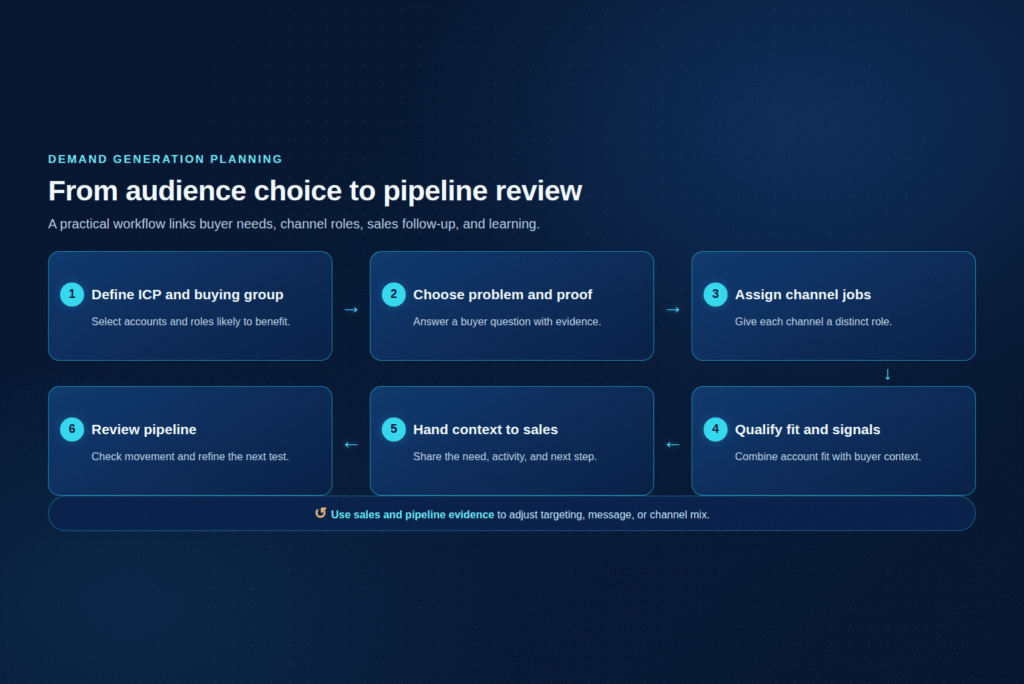
Agree on the handoff before launching the campaign. Define what makes an account worth a sales conversation. That might include ICP fit, a relevant role, a stated business problem, and a direct request to discuss a solution. A single page visit is a clue, not proof of buying intent. Combine behavior with account fit and the context of the interaction.
When a prospect is ready, pass more than a name. Sales needs to know which account the person represents, what they engaged with, what question they asked, and why the team believes a conversation would help. Set a response window and name who owns the next step. For people who are interested but early, offer a relevant follow-up rather than labeling them sales-ready to meet a volume target.
The handoff also runs in the other direction. Sales should record whether a lead was accepted, delayed, or rejected, and give a reason. If poor-fit accounts keep appearing, revisit targeting. If the right accounts respond but meetings do not happen, look at the offer, timing, or follow-up. A Demand Generation Strategy improves when both teams can see the same evidence and change the part that is failing.
Measure progress beyond raw lead counts
Keep clicks, impressions, downloads, and email opens as diagnostic measures. They can show whether a message reached people or prompted activity. They should not stand in for revenue progress. HubSpot’s current guide recommends looking at qualified leads, pipeline, velocity, and win rate rather than raw contact volume alone.
A practical scorecard can include target-account reach, buying-group coverage, sales-accepted leads, meetings held, conversion between pipeline stages, time to next stage, and opportunities created or influenced. Compare performance by segment and channel. Track spend and the cost of qualified outcomes. For longer sales cycles, review early engagement on one schedule and pipeline movement later; do not declare a campaign a failure because an enterprise deal did not close in its first month.
Attribution deserves caution. A prospect may see an ad, read an article, talk with a peer, and later attend a sales meeting. A reporting system can assign credit to these touches, but that does not prove which one caused the purchase. Use attribution to ask better questions, then compare it with sales feedback, cohort trends, and controlled tests where practical. Do not make a budget decision from a single dashboard number.
What to expect from B2B Demand Generation Services
A provider should be able to explain the audience, message, channels, data sources, qualification rules, and reporting before work begins. Ask how it will protect list quality, verify account fit, handle outdated contacts, and make sure the handoff supports sales rather than overwhelming it. Ask who owns each step and what happens when the first campaign misses its target.
Check whether the provider can work across planning and execution. A team might need audience research and messaging first, then paid outreach, intent signals, data enrichment, appointment setting, or reporting. Buying an isolated list or a large batch of meetings will not fix a weak offer or an unclear ICP.
IntentFlow Media describes its public offer around ICP and account targeting, outbound and paid campaigns, intent signals, data enrichment, appointment setting, and pipeline reporting. Those are components to evaluate, not a promise of any particular result. Teams considering the provider can review its B2B Demand Generation Services page and compare the stated scope with their own data, sales capacity, and goals. The existing B2B demand generation plan for tech companies also lays out a seven-step planning process that complements this broader article.
Before a test begins, agree on the audience sample, outreach volume, opt-out handling, sales acceptance rules, and what counts as a qualified conversation. Ask for a sample report with account-level context and explicit pipeline stages; the review can then separate poor fit from a channel or follow-up problem.
FAQs
What is a Demand Generation Strategy?
A Demand Generation Strategy is a plan for building awareness and trust with suitable buyers, then helping interested prospects take a relevant next step. It connects audience, content, channels, sales handoff, and pipeline measurement.
How is demand generation different from lead generation?
Demand generation includes work that builds interest before someone is ready to buy, along with ways to capture active interest. Lead generation focuses more narrowly on identifying and qualifying people or accounts for follow-up. A program may use both, but a form fill alone does not show that a buyer is sales-ready.
What should a B2B demand generation campaign measure?
Track whether the campaign reaches the right accounts and roles, whether sales accepts and holds conversations, and whether opportunities move through the pipeline. Use clicks and downloads to diagnose activity, not as the sole proof of success.
