A strong lead nurturing strategy helps businesses stay connected with potential customers long after the first interaction. Most prospects don’t visit a website, request information, and immediately make a purchase. They compare options, research solutions, talk to colleagues, and often disappear for weeks before returning. Without a clear plan for staying engaged throughout that process, many promising opportunities are lost before sales teams ever have a meaningful conversation.
That’s where lead nurturing comes in.
Instead of treating every lead as sales-ready, businesses guide prospects through a series of interactions designed to build trust, answer questions, and move them closer to a buying decision.
Why a Lead Nurturing Strategy Matters
Generating leads is only the beginning.
A marketing campaign might attract hundreds of visitors. Some download a guide. Others register for a webinar. A few request a product demo.
Very few are ready to buy immediately.
Research across multiple industries consistently shows that prospects often need several touchpoints before making a purchasing decision. The challenge is staying relevant during that period without becoming intrusive.
Without a structured lead nurturing strategy, businesses often make one of two mistakes.
They either stop communicating entirely.
Or they overwhelm prospects with constant sales messages.
Neither approach works particularly well.
The most effective organizations focus on providing useful information at the right time while gradually moving prospects through the buying process.
Understanding How Buyers Make Decisions
Most purchasing journeys are not linear.
A prospect might discover a company through a blog post. Two weeks later, they attended a webinar. A month after that, they download a pricing guide. Then nothing happens for another six weeks.
Eventually, they contact sales.
From the company’s perspective, it can feel unpredictable.
From the buyer’s perspective, they’re simply gathering information at their own pace.
Effective lead nurturing campaigns recognize this reality.
Rather than pushing for an immediate sale, they support the buyer’s journey with relevant content and communication.
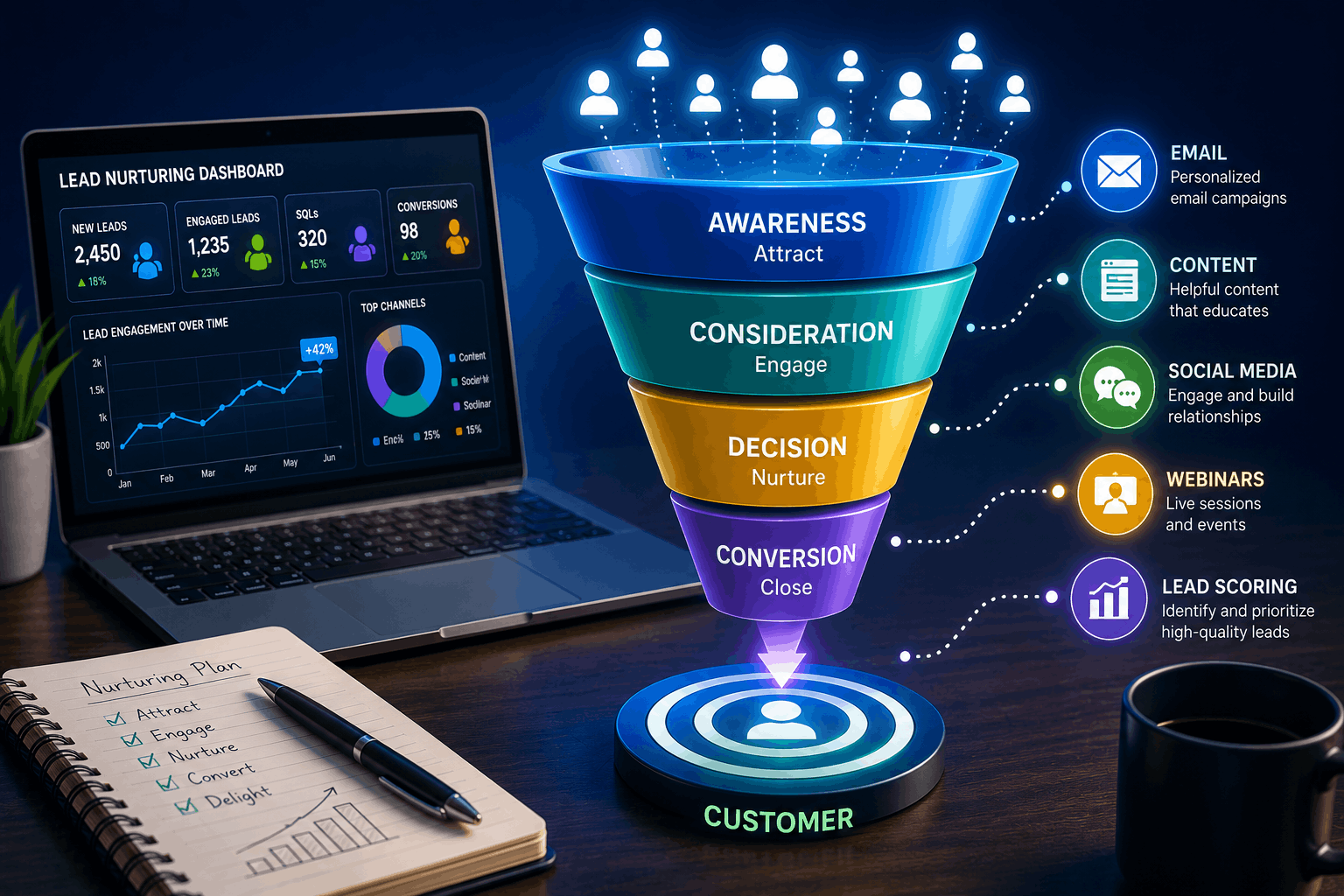
The Different Stages of Lead Nurturing
Not all leads need the same information.
Someone learning about a problem for the first time requires a different approach than someone comparing vendors.
Awareness Stage
At this point, prospects are trying to understand a challenge.
They may search for answers, read articles, or explore educational content.
Useful assets include:
- Blog posts
- Industry reports
- Educational videos
- Research studies
- Checklists
The goal is not to sell.
The goal is to help.
Consideration Stage
Prospects begin evaluating solutions.
They know the problem exists and want to understand available options.
Common content includes:
- Webinars
- Product comparisons
- Case studies
- Expert guides
- Industry benchmarks
This stage often benefits from carefully planned lead engagement efforts.
Decision Stage
Now prospects are comparing providers.
They want evidence, pricing information, and proof that a solution will deliver results.
Effective content may include:
- Product demos
- Customer testimonials
- Free trials
- Consultations
- ROI calculators
At this point, sales and marketing should work closely together.
Common Channels Used for Lead Nurturing
A successful lead nurturing strategy rarely depends on a single communication channel.
Prospects interact with businesses in different ways.
Using multiple channels helps maintain visibility without becoming repetitive.
Email Marketing
Email remains one of the most effective tools for lead nurturing.
A well-designed email sequence can deliver valuable information over weeks or months.
For example:
Week 1: Educational article
Week 2: Industry report
Week 3: Customer success story
Week 4: Product demonstration
Each message serves a purpose.
The objective is gradual relationship building rather than immediate conversion.
Content Marketing
Content often serves as the foundation for long-term lead-nurturing campaigns.
Every article, guide, or resource creates another opportunity to engage prospects.
Useful content formats include:
- Blog articles
- White papers
- E-books
- Video tutorials
- Industry research
The best content answers questions buyers are already asking.
Social Media
Many prospects continue researching long after leaving a website.
Social platforms help businesses stay visible during that process.
Sharing useful content, customer stories, and industry insights can support ongoing lead engagement without creating sales pressure.
Webinars and Events
Live interactions provide opportunities to build trust.
Prospects often gain confidence when they can ask questions and hear directly from experts.
Webinars also create valuable opportunities for lead qualification because attendee behaviour often reveals purchase intent.
How Lead Scoring Improves Nurturing
Not every lead deserves the same level of attention.
This is where lead scoring becomes valuable.
Lead scoring assigns values to actions and characteristics.
For example:
| Activity | Score |
|---|---|
| Opens email | +5 |
| Downloads guide | +10 |
| Attends webinar | +20 |
| Requests demo | +30 |
| Visits pricing page | +15 |
As scores increase, businesses gain a clearer understanding of purchase readiness.
Combining lead scoring with lead nurturing helps organizations prioritize resources more effectively.
Sales teams focus on highly engaged prospects.
Marketing continues nurturing everyone else.
Personalization Makes a Difference
Generic communication rarely produces strong results.
Prospects expect relevance.
A manufacturing executive and a healthcare administrator may both download the same resource. Their challenges, however, are completely different.
Personalization can include:
- Industry-specific content
- Customized email sequences
- Behavioral triggers
- Relevant case studies
- Targeted recommendations
The more relevant the experience feels, the stronger the response tends to be.
This is one reason modern lead management platforms have become increasingly sophisticated.
They allow businesses to deliver tailored experiences at scale.
Common Lead Nurturing Mistakes
Many organizations invest significant effort into generating leads but undermine results with poor nurturing practices.
Focusing on Sales Too Early
One of the fastest ways to lose a prospect is to push for a purchase before trust has been established.
People rarely appreciate aggressive sales messages immediately after downloading a guide or attending a webinar.
The relationship hasn’t developed yet.
Sending the Same Message to Everyone
Different prospects have different needs.
Treating every lead identically reduces engagement and lowers conversion rates.
Segmentation matters.
Ignoring Existing Customers
Many businesses focus exclusively on new opportunities.
Current customers often represent additional revenue opportunities through upselling, renewals, and referrals.
A strong customer journey doesn’t end after the first purchase.
Inconsistent Communication
Long periods of silence create problems.
Prospects forget companies surprisingly quickly.
Consistency helps maintain awareness without overwhelming recipients.
How Marketing Automation Supports Lead Nurturing
Managing hundreds or thousands of prospects manually is unrealistic.
Automation solves this problem.
Modern marketing automation platforms can:
- Trigger emails automatically
- Segment audiences
- Track engagement
- Update CRM records
- Support lead qualification
- Manage workflows
Technology doesn’t replace strategy.
It makes execution easier.
Businesses still need a clear understanding of their audience, messaging, and goals.
Automation helps deliver those experiences efficiently.
Measuring Success
A lead nurturing strategy should be evaluated using measurable outcomes.
Common metrics include:
- Email open rates
- Click-through rates
- Conversion rates
- Opportunity creation
- Revenue influenced
- Time to conversion
These indicators provide insight into what’s working and where improvements are needed.
Regularly monitoring performance allows teams to refine messaging, adjust timing, and improve overall results.
Real-World Example of Lead Nurturing in Action
Imagine a software company targeting HR leaders.
A visitor downloads a guide about AI adoption in the workplace.
The company doesn’t schedule a sales call immediately.
Instead, the prospect enters a structured lead nurturing campaign.
During the following weeks, they receive:
- Industry research
- AI implementation examples
- Case studies
- Webinar invitations
- Product-related educational content
As engagement increases, lead scoring identifies growing interest.
Eventually, the prospect attends a product demonstration and requests pricing information.
By the time sales becomes involved, the buyer already understands the problem, knows the solution category, and trusts the company providing information.
That’s the real purpose of lead nurturing.
It’s not about sending more emails.
It’s about helping prospects move forward when they’re ready while keeping your business visible throughout the decision-making process.
The organizations that consistently generate qualified opportunities rarely rely on a single campaign or isolated interaction. They build repeatable systems that support prospects across every stage of the customer journey, creating stronger relationships and better conversion opportunities over time.
