

A campaign can bring in hundreds of form fills and still leave sales with little to work on. B2B demand generation campaigns need a clearer job: help the right buying groups understand a problem, build enough confidence to take a next step, and give sales useful context when interest becomes real. That means planning for more than lead volume. It means connecting the audience, message, channels, follow-up, and measures before launch.
For a B2B company with a long buying cycle, one ad or webinar rarely carries the whole decision. An operations lead may read a guide, a technical evaluator may attend a product session, and a finance stakeholder may not get involved until the project has a budget. B2B demand generation campaigns should account for those different needs without treating every interaction as a sales-ready signal.
What B2B demand generation campaigns are meant to do
Demand generation creates awareness and interest across the buyer journey; lead generation captures information from people who are ready to identify themselves. The two can work together, but they are not the same activity. Salesforce describes demand generation as a longer-term program that builds brand interest and supports pipeline, while lead generation is more directly concerned with collecting prospect details.
That difference changes how B2B demand generation campaigns are planned. A gated report might collect names, but an ungated technical guide could help buyers who are still exploring the issue. A sales outreach sequence can turn account interest into a conversation, while expert content may keep a company familiar to buyers who will not purchase for months. The campaign should include the right mix for its goal, not force every asset into a lead form. B2B demand generation campaigns should make the next step fit the buyer’s stage. Keep that goal visible as assets are added.
Start with a result the business can verify. Examples include more qualified conversations from a defined account segment, increased attendance from buying-group roles, or a larger share of target accounts progressing to a product evaluation. B2B demand generation campaigns need a named outcome before channels are selected. “Get more leads” is too vague. It does not say which leads, what counts as qualified, or what sales should do when they arrive. Strong B2B demand generation campaigns define those rules before launch.
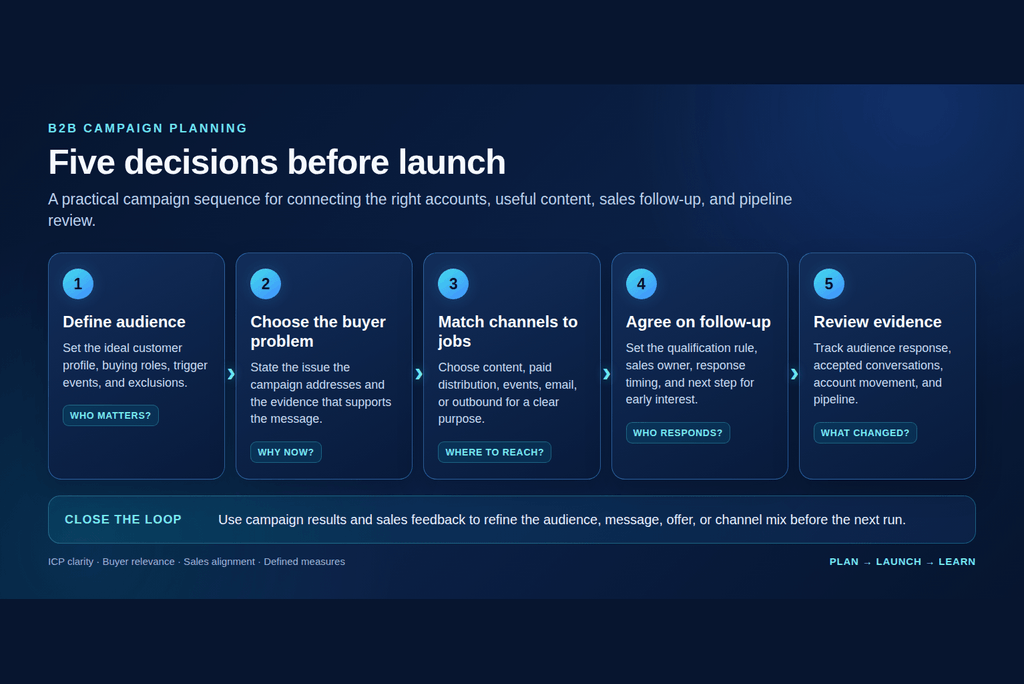
Build a B2B demand generation strategy around one buying problem
A campaign gets messy when it tries to speak to several industries, problems, and buyer roles at once. Pick one audience slice first. Define what those organizations have in common, what event might make them reconsider their current approach, and which people influence the decision. That gives B2B demand generation campaigns a useful boundary. It also makes later performance comparisons fairer.
For example, a software provider targeting security teams might focus on companies preparing for a platform audit or replacing an aging access process. The technical buyer needs to know how the product works. A security leader may ask about access controls and evidence. Finance may want a clear view of implementation costs. The central business case can stay consistent, but each asset should answer the question that matters to its reader. That is how B2B demand generation campaigns stay relevant across a buying group.
Before launch, write a one-page campaign brief with:
•The ideal customer profile and exclusions.
•The business problem and evidence supporting the message.
•The decision or action the campaign should encourage.
•The channels, asset owners, launch dates, and follow-up path.
•The primary outcome and the diagnostic measures to review.
This does not need to become a large planning exercise. A short, specific brief can prevent the common failure where paid media, email, sales outreach, and a webinar all use different promises. For B2B demand generation campaigns, one message should connect those touchpoints. Strong B2B demand generation campaigns repeat the same core idea in different useful forms; they do not simply publish the same copy everywhere. The campaign brief helps keep that difference clear.
B2B demand generation campaign examples that have a clear job
Useful B2B demand generation campaign examples are built around a buyer problem, not just a channel. A campaign might include a diagnostic article, an ungated checklist, targeted social distribution, a technical webinar, and a follow-up invitation for accounts that show deeper interest. Each piece earns its place by answering a different question or moving a buyer toward a sensible next step. That is a stronger basis for B2B demand generation campaigns than choosing channels by habit.
Example: a problem-education campaign. A company selling data integration software sees that prospects struggle to reconcile customer records across platforms. It publishes a practical guide explaining common causes, shares a short checklist through paid and organic channels, then hosts a technical session showing how teams assess the issue. The sales team follows up with attendees who request a discussion. Readers who only download the checklist continue receiving useful educational material rather than an immediate sales call.
Example: an account-focused launch. A professional services firm introduces a new compliance assessment. It selects accounts with a relevant trigger, prepares a short executive briefing and a deeper technical explanation, and gives business development staff a reason to contact each account. The campaign tracks account reach and qualified conversations, not only clicks. In both examples, B2B demand generation campaigns connect the content to an actual sales motion. Each touch has a purpose and an owner. Document that handoff in the launch plan.
Example: a customer expansion program. Existing customers may have a related need that was not part of the original purchase. A campaign can share a use-case guide, invite selected customers to a workshop, and give account managers a follow-up brief. This is different from sending a blanket product announcement. The message should reflect what the customer already uses and what problem the additional service addresses.
These B2B demand generation campaign examples are starting points, not templates to copy without checking fit. A channel that works for an established category may perform poorly for a new product with little buyer awareness. Test the audience and offer before committing most of the budget.
Connect channels without making every touch a conversion
A campaign can use search content to answer active questions, paid social to reach chosen roles, email to support an existing relationship, and outbound to start a relevant conversation with an account. Events can help when the buyer needs to hear from a technical expert or compare approaches. The combination depends on how buyers learn and how the company can follow through. That choice should shape B2B demand generation campaigns, not a channel trend.
LinkedIn’s B2B Institute presents the 95-5 rule as a reminder that most potential buyers are not ready to buy at any given moment. Its guidance argues for reaching future buyers with brand activity while also capturing demand from the smaller group currently shopping. Treat that figure as a planning lens, not a precise ratio for every product or market. The useful point for B2B demand generation campaigns is that short-term conversions do not show the full effect of staying familiar to buyers before a project begins. Include early-stage reach alongside near-term response.
Give each channel a defined role. Search content can help a buyer find an explanation. B2B demand generation campaigns should connect those roles instead of treating each channel as a separate program. Paid distribution can put that explanation in front of selected accounts. A webinar can answer deeper implementation questions. Sales outreach can add context when the account has a relevant need. If every channel is judged only by immediate form fills, the team may cut useful early-stage activity and overfund tactics that capture existing demand without creating much new interest.
Campaign management software can help teams associate multiple assets with a shared goal and view performance together. HubSpot’s campaign documentation, for example, describes organizing assets such as blog posts, social posts, ads, and emails under one campaign, then reviewing both collective and asset-level results. The tool does not fix poor campaign definitions; teams still need to name the goal and agree on what each measure means.
Link B2B lead generation campaigns to sales follow-up
B2B lead generation campaigns work best when marketing and sales agree on what qualifies as a useful response. A person who downloads an introductory guide may want more information, but that action alone does not prove that they have budget, authority, or a project in progress. A request for a product consultation from a well-matched account carries different weight.
Set a handoff rule before launch. It might include account fit, buyer role, expressed problem, and a clear request for a conversation. That rule determines when B2B demand generation campaigns should bring sales in. Decide who owns the next step and how quickly sales will respond. Pass along the content viewed, event attended, question asked, and other relevant account context. This detail helps B2B demand generation campaigns lead to more relevant conversations. This gives a salesperson a reason to make the follow-up specific rather than opening with a generic pitch.
Also define what happens to people who are not ready. They may receive a follow-up article, an invitation to a relevant event, or occasional updates tied to the problem they showed interest in. Avoid flooding the sequence with messages simply because the person entered a database. The follow-up should reflect the buyer’s stated interest and the permissions the company has to contact them. This keeps B2B demand generation campaigns useful after the initial response.
For organizations that need help coordinating these activities, IntentFlow Media describes its services around account targeting, data enrichment, outbound, paid media, and appointment setting. Its B2B Demand Generation Services page explains how those activities are organized for B2B technology and professional services teams. The company’s existing B2B demand generation plan for tech companies covers ICP selection, messaging, channel roles, account data, and sales handoffs; this campaign article can sit alongside it as the execution-level companion.
Choose demand generation campaign metrics that reflect the goal
Demand generation campaign metrics should answer two kinds of questions. First: did the campaign reach and interest the intended audience? Second: did that activity contribute to business outcomes the company values? The specific measures depend on the campaign. A brand-awareness effort and a sales-qualified appointment program should not be judged by the same primary number.
For early diagnostics, review target-account reach, relevant page visits, event registrations and attendance, content engagement, email replies, and responses from the roles the team wants to reach. B2B demand generation campaigns should separate these signals from revenue outcomes. These can show whether the message is getting in front of the intended audience. They do not, by themselves, prove that pipeline will follow.
For business outcomes, consider accepted meetings, sales-qualified opportunities, account progression, sourced pipeline, influenced pipeline, conversion between stages, and eventual revenue. HubSpot’s campaign guidance recommends setting a goal and selecting measurable results that match it, such as contacts for lead-focused programs or sessions and engagement for awareness efforts. The exact definition should be written down so the team does not change it after seeing results. Clear definitions make B2B demand generation campaigns easier to compare over time.
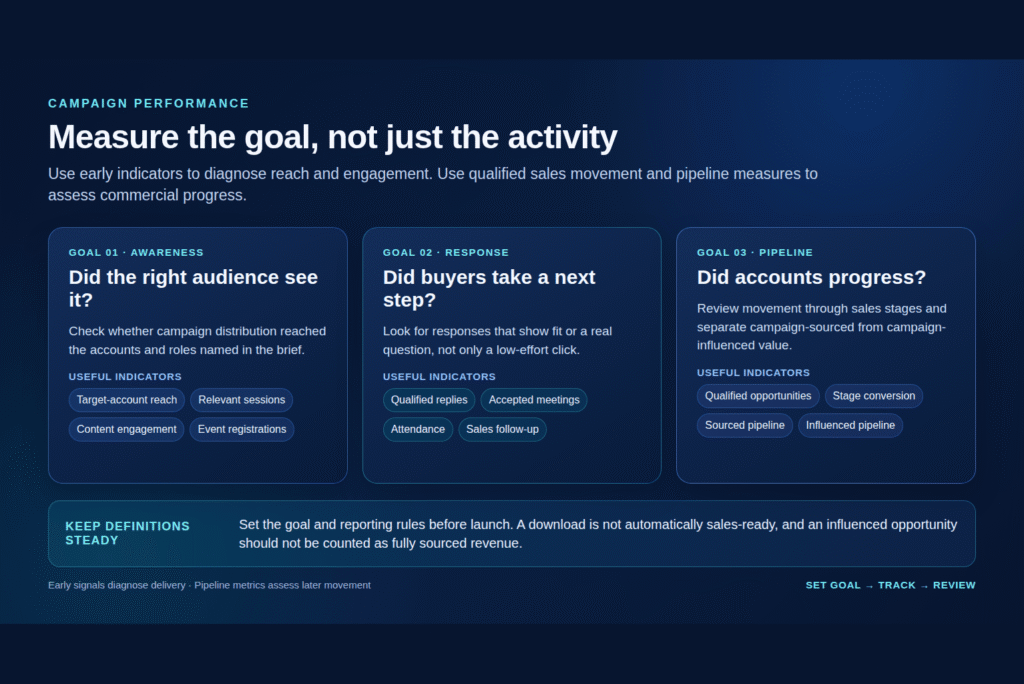
Be careful with “influenced pipeline.” One opportunity may interact with several campaigns. If each campaign receives credit for the full deal amount, totals can exceed the actual pipeline. Decide whether the report shows sourced opportunities, influenced opportunities, or a modeled share of credit. This matters when B2B demand generation campaigns are compared across channels. Keep those figures separate and explain the rule wherever the data is presented. That makes demand generation campaign metrics easier for sales and finance to interpret. It also prevents B2B demand generation campaigns from claiming the same opportunity twice.
A practical review can pair one primary outcome with a few diagnostic measures. For example, an account-based campaign might use accepted meetings from target accounts as the primary outcome, with account reach, response rate, and meeting attendance as diagnostics. A content campaign might track qualified organic visits and later account progression, while recognizing that some influence will not appear in a last-click report.
Improve B2B pipeline generation with a focused pilot
Do not launch a large channel mix before checking that the basic parts work. Run B2B demand generation campaigns against a focused segment and confirm that tracking, campaign naming, account matching, lead routing, and follow-up are functioning. A small pilot makes data gaps visible before spend expands. When the first results arrive, look for the failure point rather than declaring the entire idea successful or unsuccessful. Review the audience, offer, and handoff before changing the full B2B demand generation campaigns plan.
If few target accounts see the content, the distribution may be too narrow. If the right people visit but do not take the next step, the offer or page may not answer their concern. If responses come in but sales rejects most of them, revisit the audience criteria or qualification rule. If meetings happen but opportunities stall, the campaign may be attracting curiosity without establishing a strong business case.
Change one major variable at a time: audience, message, offer, or follow-up. Record what changed and when the team will review it. A longer buying cycle may require a later pipeline review, even if early channel indicators are available sooner. B2B demand generation campaigns should be judged on a timeline that matches the sales process, not only the first week’s dashboard. The review date belongs in the brief.
FAQs
What is the difference between demand generation and lead generation?
Demand generation builds awareness and interest among potential buyers over time. Lead generation captures details from people who respond to a specific offer or request. A company often needs both: useful activity to build familiarity and a clear path for interested buyers to identify themselves.
What are good B2B demand generation campaign examples?
Examples include a problem-education series with a guide and webinar, an account-focused product launch, or a customer expansion workshop. Each should address a specific buyer need, use channels suited to that audience, and define how sales will follow up when a relevant account responds.
Which demand generation campaign metrics should teams track?
Choose measures that match the goal. For awareness, review reach and relevant engagement. For lead capture, examine qualified responses and accepted meetings. For pipeline impact, track account progression, sourced and influenced opportunities, and later revenue. Keep definitions consistent and do not treat every click or download as a sales-ready lead.
